
This post may contain affiliate links. If you use them, it helps keep the blog going, which I appreciate
Why I Bought Another Flat Iron
I really should not have bought this flat iron.
I was looking for a better-quality flat iron, and this one was all over TikTok. It was a semi-impulsive purchase. Unlike the Beachwaver, which was purely impulsive, I was already thinking about getting a new flat iron. My purple Conair from 2018 was working just fine, but I wanted something that would help me style my hair faster, give me better control over the temperature, and feel better in my hands.
It’s been almost 10 years. Surely hair technology has come a long way since then.
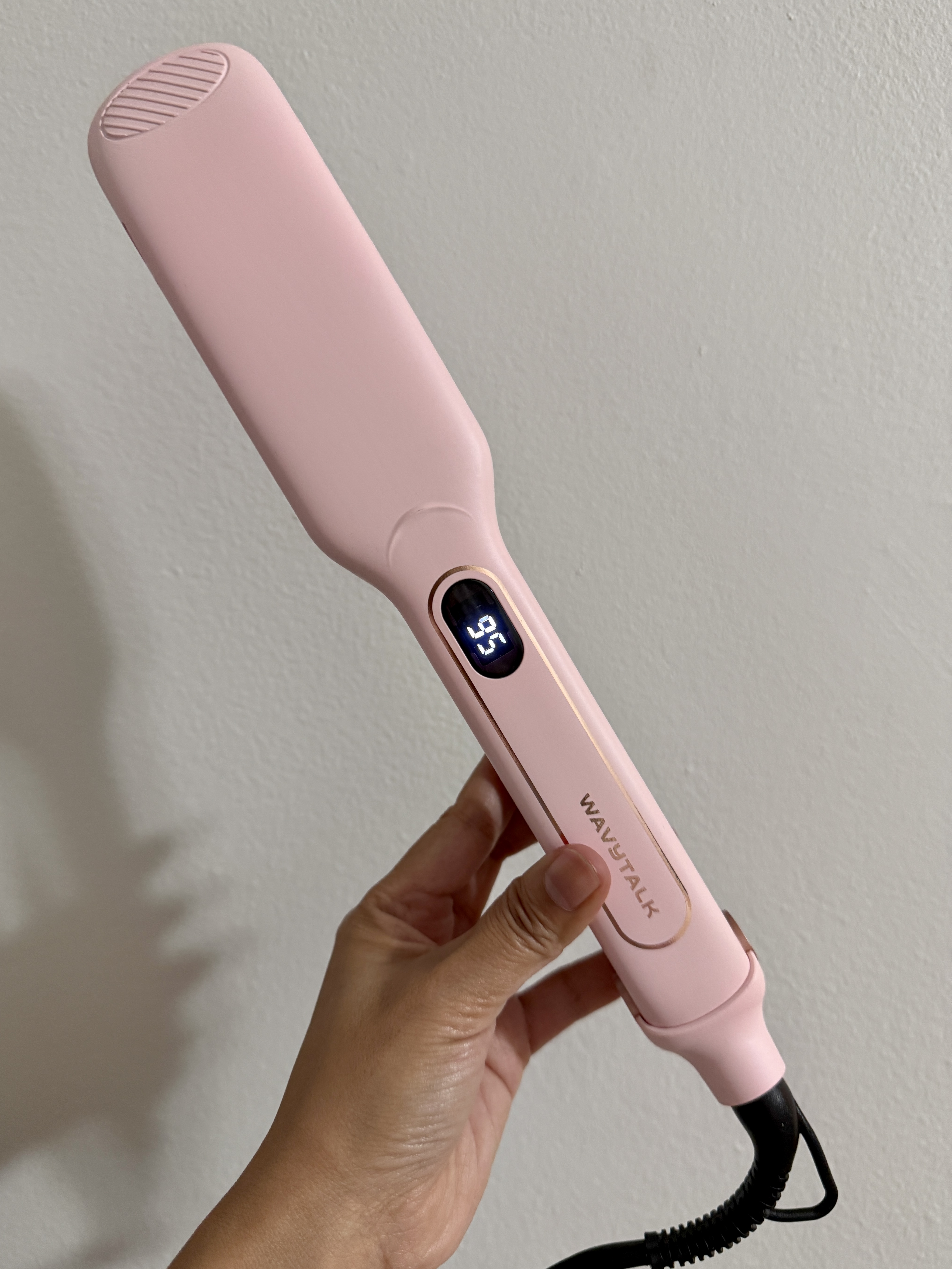
There were three reasons I bought the Wavytalk Vent Sesh: it could be used on damp or dry hair, the plates were large, and it was pink.
Those aren’t super great reasons to buy another flat iron, but since I’m on a quest to find hair tools and products that make life easier, it made sense to give it a shot. The price was reasonable, so I clicked “add to cart.”
The Flat Iron That Changed My Mind About Big Plates

I grew up in the CHI era when skinny plates were the thing. I thought it wasn’t cool not to have skinny plates.
Then, in 2018, I was traveling for work and needed a flat iron. I bought a purple Conair from CVS with bigger plates, and it was like a symphony started playing.

I discovered that larger plates are better for my hair because I can take bigger sections and get away with one pass. With the amount of hair I have, that saves a lot of time.

There’s honestly nothing wrong with this Conair. It works incredibly fast, doesn’t pull at my hair, and can be used on damp or dry hair. I appreciated that last feature because sometimes I’d run late after a shower and my hair wouldn’t be completely dry. I know using a flat iron on damp hair isn’t necessarily ideal, but I liked having the option.
My biggest complaint is its temperature control. Instead of displaying the actual temperature, it has settings from 1 through 6.
Finding a flat iron that specifically advertises damp-hair compatibility isn’t as easy as I expected. There are newer tools that use airflow, but they’re more expensive, and I wasn’t ready to try one yet.
Why I Flat Iron Hair That’s Already Straight
I’m not asking for a flat iron to transform my texture. My hair is naturally very straight. Like painfully straight.
I use a flat iron because it’s a quick way to look insanely polished.


There’s some noticeable waving around my face, and my hair doesn’t always fall together as smoothly as I’d like. After flat ironing, those little waves are smoothed out, the flyaways are under control, and my hair has a nice shine.
Sometimes it almost seems like it doesn’t belong to me, kind of like a wig.
That’s what I’m trying to accomplish. I’m not looking to transform my hair into something completely different. I just want it to look polished without spending forever styling it.
First Impressions Were Promising
Out of the package, everything seemed promising.

The Vent Sesh came in a black velvet storage bag, and the flat iron itself had a smooth, almost velvety finish. It felt nice to hold. The buttons looked sleek, and the locking mechanism blended into the design instead of looking like something that had been added as an afterthought.


The lock reminded me of the one on my Voloom. It’s primarily useful for storage, but I appreciate when something like that is comfortably designed and easy to use.
This really felt like Apple did a flat iron.
For the price, I thought it felt surprisingly premium. The Vent Sesh is physically larger than my Conair, but they feel about the same weight.


It had the features I wanted, too. A digital temperature display, a safety lock, larger plates, and the ability to straighten damp or dry hair. It also gets as hot as I need it to.
I have mixed feelings about the automatic shutoff feature.
I don’t care for auto shutoff because I don’t want to discover several minutes into styling that my flat iron has turned itself off. I haven’t had that happen with the Vent Sesh, but with the amount of hair I could potentially be straightening, including someone else’s, I don’t want to worry about it.
On the other hand, one of my biggest fears is leaving a hot tool plugged in. I can absolutely imagine styling my hair, leaving for an event, and wondering whether there’s a flat iron sitting on my bathroom counter being hot.
Ugh.
So yes, I understand why automatic shutoff exists. I just don’t necessarily want my flat iron making that decision for me.
Before using it on my hair, I let the Vent Sesh heat up and passed a towel between the plates. I also held my hand between the open plates to get a sense of the heat. Everything seemed to be heating evenly, and I didn’t notice anything that made me concerned about how it would perform.
Then I made my first pass through my hair.
The Plates Are the Problem
I felt tugging almost immediately.
At first, I thought I needed to adjust how I was sectioning my hair. I was taking the same sections I normally would with my Conair, but the Vent Sesh wasn’t giving me the same results.
That’s when I started paying closer attention to how the plates were closing.

The plate contact isn’t even. When I close the Vent Sesh, the plates come closer together toward the outer end than they do near the hinge. You can see the difference in the photo.
I can also feel it when I squeeze the straightener shut. There’s almost a bounce to it, as though the pressure isn’t being distributed evenly. I grabbed my Conair to compare, and it didn’t have that same feeling.
When I passed the Vent Sesh through my hair, I could tell which parts of a section had made better contact with the plates. The results weren’t consistent, even though my hair was already straight.
I eventually figured out that I needed to take smaller sections and deliberately position my hair closer to the outer end of the straightener. That helped me get a more even result, but it didn’t eliminate the tugging.
And the tugging happened with every pass.
My scalp can tolerate some pulling, like when I’m brushing through knots. But when individual hairs are being tugged all the way down the shaft, it’s an ouch party.
I can’t say with scientific certainty that I doubled the number of sections I needed to straighten my hair. I wasn’t standing in my bathroom with a clipboard conducting a flat iron experiment. But I know how much hair I normally put through my Conair, and with the Vent Sesh, I had to cut those sections in half and sometimes divide them even further.
It felt like forever.
I spent a couple of weeks trying to figure out how to make the Vent Sesh work for me. Then I realized I shouldn’t have to do any of this.
I was annoyed.
Did It Earn a Spot?
No. I’m going to sell it. I’m totally bummed.
At the end of the day, the Vent Sesh did its job. It did, indeed, straighten my hair. I wasn’t disappointed with the results. I was disappointed with what it took to get them. Between the uneven plate pressure, the constant tugging, and having to adjust how I sectioned my hair, using it became more work than I wanted.
I really wanted this to be the yin to my yang. It looked great, felt premium for the price, and had nearly everything I was looking for. Unfortunately, none of that makes up for the actual experience of using it.
I’m still looking for larger plate flat iron. I don’t necessarily need something lighter than the Vent Sesh, but I certainly don’t want anything heavier. I’m even willing to give up the damp-hair feature if it means finding something that performs better.
I’m interested in trying a flat iron with airflow technology at some point, but I’m just not there yet.
Apparently my emergency CVS purchase from 2018 has set a higher bar than I realized.
Leave a Reply