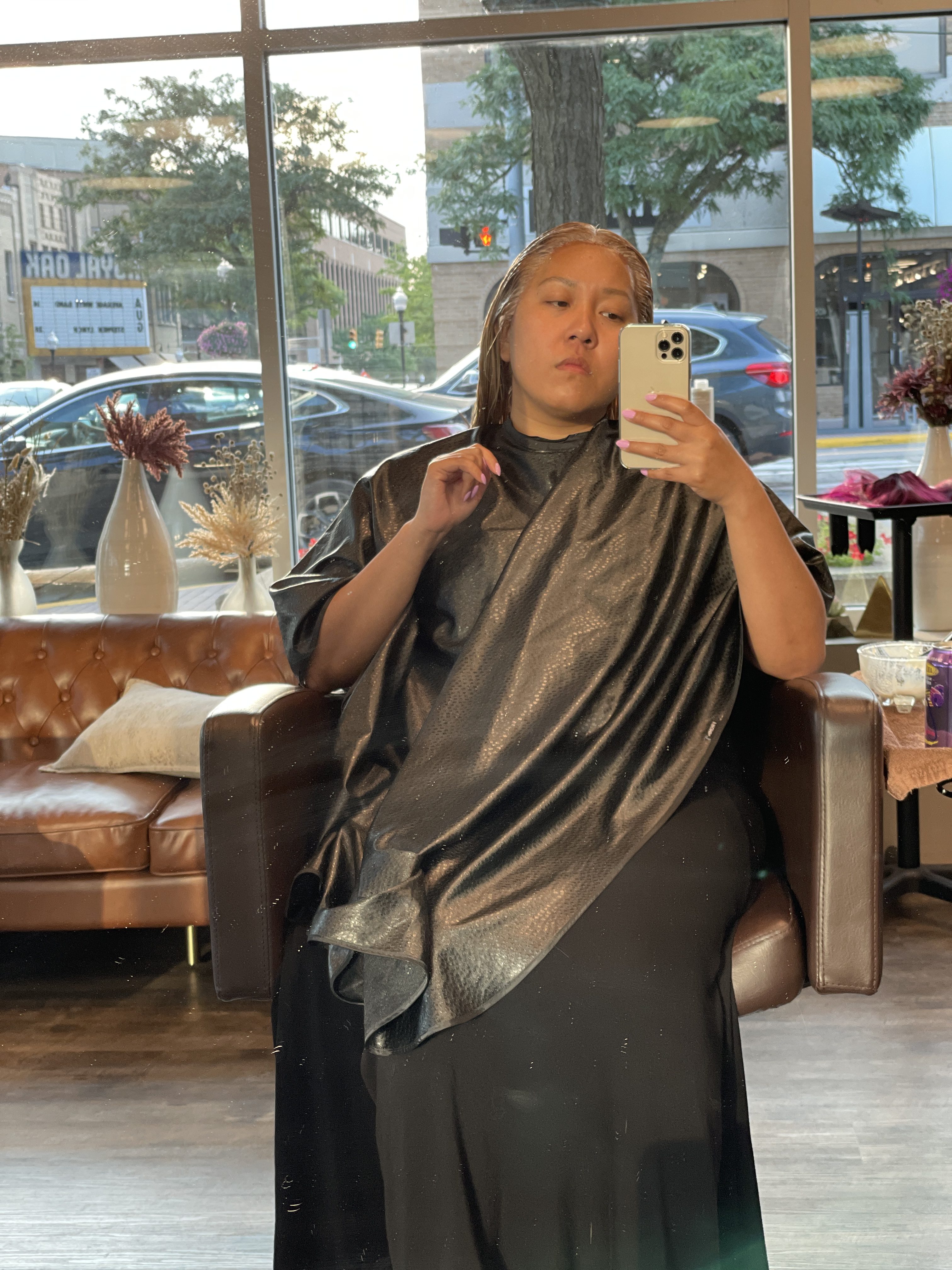

There was a period where I consistently scalp bleached my hair. I’m not exactly sure how long it lasted, but I know it wasn’t even a year.
The first time I ever heard about scalp bleaching was when I was a sophomore in high school. A girl in one of my classes had just gotten her hair done, and everyone was talking about how her scalp was bleeding. I only saw her during second hour, and because of the way our classroom was set up, I never actually saw the back of her head. At that point in my life, I had absolutely no experience with that level of bleaching, but the story stuck with me.
Years later, after a little Googling and plenty of conversations with my hairdresser, I knew scalp bleaching wasn’t supposed to be agonizing. There might be heat or tingling, but if you’re in severe pain, something probably isn’t right.
What never occurred to me was the maintenance. I wasn’t thinking about appointments every five or six weeks. I was just amazed at how blonde people could get.
I also didn’t know what scalp bleaching actually was. To me, bleach was bleach. I never stopped to think about all the different techniques and placement involved. I realized pretty quickly that blonding is an art, and scalp bleaching was simply another technique. It only became something I considered because it was presented as an option. I never sat around Googling how to become as blonde as possible.
How I Ended Up Scalp Bleaching
This was after the pandemic when I found my current hairdresser.
During our consultation, he determined I needed a color correction because so much time had passed since my previous appointments. Looking back, I probably should have explained more about how my previous stylist had been coloring my hair.
I’ll be honest, it wasn’t that I didn’t want to become a scalp bleaching girl. I just didn’t want to tell someone else how to do their job. He was the captain of the ship now, and I trusted him.
My previous stylist had always packed my hair with foils. We never really talked strategy. If it wasn’t broken, I didn’t see a reason to fix it. Whenever she wanted to try something different, I usually went along with it.
The funny part is I probably never would have asked for a scalp bleach because I didn’t actually know what it was called. When my new hairdresser suggested it, it sounded like an opportunity. I’d never been that blonde before, and my hair had already been pretty light before the pandemic, so I figured, why not? I wasn’t nervous. I was curious.
My First Scalp Bleach

My first appointment was after work in the middle of summer. I was sweaty, so I made what I thought was the responsible decision and washed my hair beforehand. I just didn’t want to be gross.
That turned out to be one of the worst decisions I could have made.
By washing my hair, I’d stripped away the natural oils that help protect your scalp during bleaching.
The bleach worked surprisingly fast. I can’t remember exactly how long it stayed on my scalp, but it was much shorter than I expected. My hairdresser warned me I’d probably feel heat or tingling, but that it shouldn’t actually be painful.
He was right.
It wasn’t pain.
It was heat.
Very intense heat.
I was so uncomfortable that I actually stood up and started doing a little step-touch dance while I waited. I didn’t care if people thought it looked odd. It takes a lot for me to get embarrassed. Looking back, I probably should have said something, but I really wanted this level of blonde. I also didn’t want to seem like a baby.
The bleach smelled like something that would make your eyes water if you got close enough to it. I wasn’t watching myself in the mirror because I’d rather have the chair turned around so my hairdresser could work. As much as I like staring at myself, curing a scalp bleach isn’t really the time.
At one point I remember wondering if I was about to lose some of my hair. It was a very brief thought, but I definitely had it. When it was finally time to rinse everything out, my immediate thought was, “Finally.”
The tingling doesn’t last the entire appointment, but when it hits, it’s real.
What I Learned
That first appointment taught me a lot.
The biggest lesson was not to wash my hair right before a scalp bleach. My previous hairdresser had always told me not to wash my hair before appointments, but there were plenty of times I ignored that advice and never noticed a difference because she mostly worked with foils. Bleach sitting directly on your scalp is a completely different experience.
I also learned that it’s okay to tell your stylist when something feels uncomfortable. Everything turned out fine, but simply saying, “Hey, this feels pretty intense,” probably would have made me feel a little calmer.
I also wish someone had prepared me for how strict the maintenance schedule would be. Once I understood how bleach behaves on fresh regrowth versus previously bleached hair, I didn’t want to push my luck and end up needing another color correction or dealing with banding. The schedule wasn’t very forgiving, and I constantly felt like I was racing the calendar.
If I could tell my younger self one thing, it would be this: it’s absolutely worth trying, but you’ll probably get tired of maintaining it sooner than you think.
My Second Scalp Bleach
The second appointment was completely different.
I skipped washing my hair beforehand and, wow…what a difference.
I’m not sure if my scalp had adjusted or if the extra oils made that much of an impact, but the appointment felt like a cakewalk compared to the first one.
The first appointment was an intense tingle.
The second appointment just…tingled.
I walked into that appointment nervous because I didn’t want to relive the first experience. Within about five minutes, I realized this one wasn’t going to be anything like it.
This was also around the time I started developing a friendship with my hairdresser. I don’t think I necessarily became more confident during later appointments. I think I just let my guard down and relaxed into the process.
Why I Stopped

Even though I got used to scalp bleaching, I didn’t stick with it very long.
The maintenance became a lot.
I was back in the salon every five or six weeks, spending roughly $400 to $500 every appointment. Between rushing there after work, leaving when it was already dark outside, and keeping up with the schedule, it quickly became more than I wanted to commit to.
I realized the schedule wasn’t sustainable once I started dating. I couldn’t be in two places at once. I wanted to spend my time differently, so I started looking for another way to stay blonde.
The amount of time bothered me first, and the cost followed right behind it. I never sat down and calculated how much I was spending every year because, honestly, I didn’t want to know. I already knew it was a lot.
After investing that much time into scalp bleaching, I also felt committed to the schedule. I didn’t want to ruin everything I’d already done by stretching appointments too far.
That’s ultimately what pushed me toward foils.
It wasn’t the scalp bleaching itself that made me stop.
It was everything that came with maintaining it.
Conclusion
These days I’ve leaned much more into foils, but I’m never saying never to another scalp bleach.
Scalp bleaching wasn’t nearly as scary as I expected.
The maintenance was.
It’s something I never imagined I’d get to experience, and honestly, I’m glad I did. I was probably most surprised that I didn’t feel the urgency to keep maintaining it. By that point, I’d already been blonde for so long that scalp bleaching felt like reaching the final level. It was something I never thought I’d get to experience with my hair.
If you really zoom out, scalp bleaching is a lot of very strong chemicals sitting directly on your scalp. I don’t think it’s something anyone should do on a whim.
That said, if your stylist thinks you’re a good candidate and you’re curious, I do think it’s worth having the conversation. I haven’t completely ruled out scalp bleaching again myself.
Like all good songs, though, the ’90s eventually come to an end.
I guess my scalp bleaching era did too.
Leave a Reply